By clicking “Accept”, you agree to the storing of cookies on your device to enhance site navigation, analyze site usage, and assist in our marketing efforts. View our Privacy Policy for more information.
Your preference will be stored for this browser and device. If you clear your cookies, your preference will be forgotten.
Best enterprise loyalty software in 2026: 15 platforms compared
Anna Olszewska
June 3, 2026
At enterprise scale, loyalty software is infrastructure, not a marketing toy.
The best loyalty platforms turn customer data into rewards that actually feel personal.
Modular beats monolithic: build and scale loyalty on your terms.
Table of contents
Enterprise loyalty software is not just a points engine. At enterprise scale, it needs to support millions of customer profiles, real-time validation, POS and ecommerce integrations, CRM and CDP data, regional rules, approval workflows, and three internal teams that all think they own the program. That is where many loyalty projects go sideways.
This guide compares 15 enterprise loyalty software platforms across architecture, flexibility, integration depth, governance, and speed to market. Some are classic suite-style vendors. Some are managed-service partners. Others are API-first and composable.
The goal is to help you find the right fit for your unique use case.
What enterprise loyalty buyers should actually evaluate?
Before you get distracted by the feature bingo, start here:
Architecture fit: Can the platform work with your stack or does your stack need to rearrange itself to please the platform?
Program flexibility: Can you model points, tiers, vouchers, referrals, wallets, and market-specific rules without filing a support request every time?
Channel coverage: Web, app, POS, CRM, CDP, email, wallets. Loyalty is never just one channel.
Governance: Enterprise programs need role controls, approvals, auditability, and room for multiple markets or business units.
Speed to market: A loyalty platform that takes forever to launch is still a very expensive slide deck.
Support for change: The real test is whether you can still change loyalty logic six months later.
How we evaluated enterprise loyalty platforms
We compared each platform across six enterprise buying criteria:
Architecture fit: suite, API-first, composable, managed service, or Salesforce-native.
Program flexibility: points, tiers, wallets, referrals, rewards, vouchers, you name it.
Integration depth: commerce, POS, CRM, CDP, and more.
Governance: permissions, auditability, approvals, regional control, and performance under load.
Speed to market: how quickly teams can launch and change loyalty logic.
Optimization readiness: whether the platform supports testing, iteration, and real-time incentive decisions.
Voucherify is included in this comparison. We are clear about where Voucherify fits, where it does not, and which alternatives may be better for teams looking for managed services, packaged front ends, or suite-native loyalty. The list was updated on June 3rd, 2026.
Support and versioning may become more contract-heavy over time.
Shortlist if: you value enterprise tailoring and deployment flexibility.
Skip if: fast iteration and painless upgrades matter more than custom vendor-managed setup.
If you are weighing Comarch specifically, it is worth reading why some teams look for a Comarch loyalty alternative.
3. Arvato Loyalty Management
Best for: Brands that want a full-service loyalty and CRM partner, not just software.
Green flags:
Strong CRM integration background across Microsoft Dynamics, SAP, Salesforce, and Spryker.
Comes with consulting and broader support.
Good fit for teams that want a delivery partner around the platform.
Red flags:
Likely expensive.
Strict contracts and a full-service model can reduce flexibility when priorities shift.
Shortlist if: you want a strategic services partner wrapped around loyalty delivery.
Skip if: you want more room to change direction quickly.
4. SessionM (now part of Capillary Technologies)
Best for: Enterprise teams that want unified customer profiles, real-time decisioning, and ROI visibility in large, data-heavy loyalty environments, and are comfortable buying into Capillary's broader portfolio.
Status note: Capillary Technologies completed its acquisition of SessionM from Mastercard on May 1, 2026. This means you are buying into Capillary's roadmap and support structure.
Green flags:
Strong customer-data and profile-unification story.
Strong APIs.
Now owned by a loyalty-focused company rather than sitting inside a payments giant, which may mean tighter product focus over time.
Red flags:
Post-acquisition integration is still ongoing. Ask how SessionM's roadmap, support, and pricing fit into Capillary's wider product line, and what stays supported long term.
Premium enterprise positioning can mean a heavier buying and implementation process.
Shortlist if: customer intelligence and enterprise scale matter more than a lightweight rollout, and you are comfortable with Capillary as the long-term vendor.
Skip if: you want a standalone platform with a settled, independent roadmap, or you would rather not re-evaluate after a recent ownership change.
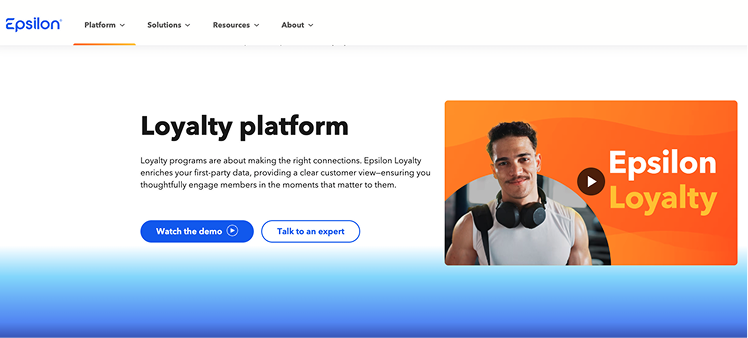
5. Epsilon
Best for: Big brands that want loyalty tied to broader identity, personalization, and strategic marketing support.
Green flags:
Strong identity and profile-building angle.
Can support both basic and complex loyalty strategies.
Includes strategic consultation.
Red flags:
Deep customization can get expensive.
Feels more like an enterprise engagement environment than a lightweight loyalty engine.
Shortlist if: you want loyalty woven into a broader identity, data, and personalization strategy with strategic support.
Skip if: you want a focused, lightweight loyalty engine rather than a full engagement environment.
6. Kobie Loyalty Cloud
Best for: Enterprises that want loyalty plus managed support and creative services.
Green flags:
Positions its engine as easy to configure without heavy custom dev.
Includes AI-driven guidance and cloud scaling features.
Adds creative and service support on top of the platform.
Red flags:
The value story leans heavily toward a service-rich relationship.
Not the clearest fit for teams that want a pure infrastructure play.
Shortlist if: you want a partner that brings services as well as software.
Skip if: you prefer a more self-directed loyalty model.
7. Fielo
Best for: Salesforce-centric organizations running loyalty across customers, partners, or employees.
Green flags:
Salesforce-native architecture is a real advantage for teams already there.
Broad enough to handle customer, channel-partner, and employee incentive scenarios.
Red flags:
Most compelling when Salesforce is already home base.
Outside that ecosystem, the differentiation is less obvious.
Shortlist if: Salesforce is core to how your business operates.
Skip if: you do not want your loyalty choice heavily tied to the Salesforce world.
8. Cheetah Digital (now part of Zeta Global, via Marigold)
Best for: Marketer-led teams that want loyalty inside a broader customer-engagement and messaging stack.
Status note: Cheetah Digital became "Cheetah Digital by Marigold," and in early 2026 Zeta Global acquired Marigold's enterprise software business, including the Cheetah and Loyalty products. If you evaluate it, you are evaluating a component of Zeta's marketing cloud, not an independent loyalty vendor.
Green flags:
Real-time monitoring across multiple data sources.
Strong security and compliance posture.
Built-in offer management and personalization fit broader CRM use cases.
Red flags:
Reads more like a broad engagement suite than a focused loyalty engine, and the ownership change reinforces that. Loyalty is one module inside a much larger martech portfolio.
Two acquisitions in, roadmap and branding are still settling. Ask what is actively invested in versus maintained.
Shortlist if: you want loyalty tightly connected to messaging and engagement, and you are comfortable inside a large suite.
Skip if: you want a focused, independent loyalty platform with a clear standalone roadmap.
9. AnnexCloud Loyalty Experience Solution
Best for: Teams that want modular retention mechanics beyond loyalty, like referrals, UGC, and gamification.
Green flags:
Open API and 100+ pre-built integrations, including native connectors to Salesforce, SAP, Adobe, and Oracle.
Modular expansion path across referrals, gamification, UGC, and more.
Strong configuration flexibility for rewards, tiers, expiration, and personalization.
Red flags:
Implementation can be resource-intensive.
Less experienced dev teams may struggle more.
Shortlist if: you want modular breadth and have enough technical maturity to support it.
Skip if: your team is small or needs a very low-friction implementation.
10. Emarsys (SAP)
Best for: SAP-aligned teams that want loyalty inside a larger omnichannel engagement setup.
Green flags:
Strong omnichannel positioning, with native loyalty inside SAP's customer-engagement platform.
Useful if you want loyalty connected to broader customer journey data and tactics.
SAP Commerce Cloud connectivity is a clear fit signal.
Red flags:
The value is strongest when paired with other Emarsys or SAP components.
Less compelling as a standalone loyalty buy.
Shortlist if: you already live in SAP or Emarsys territory.
Skip if: you need loyalty to stay decoupled from a larger suite.
11. Antavo
Best for: Omnichannel retail brands with real in-store complexity and multi-region needs.
Green flags:
Strong in-store loyalty experience, including wallets and kiosks.
A dedicated promotion engine runs targeted promotions with or without the loyalty program, plus explicit multi-region support.
Red flags:
The story is heavily retail and in-store oriented.
Buyers without POS or regional complexity may not need that depth.
Shortlist if: retail, POS, and multi-market execution are central requirements.
Skip if: your use case is mostly digital and much simpler operationally.
12. Voucherify
Best for: Teams that want API-first loyalty plus promotions, referrals, wallets, and coupons in one place.
Green flags:
Modular architecture with a low upfront integration story.
Loyalty is part of a broader incentive stack, not an isolated module. The loyalty engine was recently rebuilt with multi-currency wallets, per-wallet earning rules, flexible point expiration, and tier-level overrides.
Developer-friendly positioning with rich docs and testing environments.
Red flags:
Best suited to teams that actually want to own their stack.
Less ideal for buyers who want a heavy managed-service model to do most of the thinking for them.
Shortlist if: you want composability, faster rollout, and one engine for multiple incentive types.
Skip if: you want a classic services-led loyalty vendor relationship.
13. Talon.One
Best for: Technical teams that want promotions and loyalty with strong flexibility.
Status note: In April 2026, Adyen announced a definitive agreement to acquire Talon.One, with the deal expected to close in the second half of 2026. The acquisition is not yet complete, but it is worth factoring in: once closed, Talon.One will sit inside a payments company, with the stated goal of connecting customer identity, promotions, and pricing at the point of payment. Ask how the roadmap and standalone availability evolve post-acquisition.
Green flags:
Headless model with customizable rules, rewards, and tiers.
Strong support reputation.
Broad campaign support beyond loyalty, including promotions, coupons, referrals, and gift cards.
Red flags:
The value is strongest if you are comfortable with a headless operating model.
Could be overkill for buyers who want a more packaged, business-user-led setup.
Shortlist if: you want real-time rule control and a technical foundation for multiple incentive types.
Skip if: you want loyalty mostly out of the box with minimal architectural ownership.
14. White Label Loyalty
Best for: Teams that want an event-based loyalty engine plus ready-made customer-facing experiences.
Green flags:
Event-based architecture is a strong hook.
AI, receipt scanning, and third-party rewards make the platform feel broader than just points.
Includes progressive web and mobile app options.
Red flags:
The pitch includes a lot of packaged experience-layer value.
Less obvious fit for teams that only want backend logic and will build everything else themselves.
Shortlist if: you want both loyalty logic and customer-facing acceleration.
Skip if: you only need an API backend and already have the frontend layer covered.
15. Open Loyalty
Best for: Teams that want API building blocks, deployment flexibility, and hands-on technical control.
Green flags:
Modular, API-first building blocks for points, tiers, challenges, rewards, and referrals.
SaaS and on-prem options.
Full source-code access is a major differentiator for certain enterprise buyers.
Red flags:
More control usually means more ownership.
The strongest value is for technical teams that actually want that flexibility.
Shortlist if: architecture control and source access matter.
Skip if: you want a more managed SaaS experience with less engineering involvement.
Best enterprise loyalty software by use case
Best for API-first teams: Voucherify, Talon.One, Open Loyalty
Best for retail and in-store loyalty: Antavo, Comarch, Oracle CrowdTwist
Best for Salesforce-centric teams: Fielo
Best for managed-service loyalty: Arvato, Kobie
Best for SAP-aligned teams: Emarsys
Best for teams wanting loyalty plus promotions in one engine: Voucherify, Talon.One, Antavo
Best for source-code access: Open Loyalty
Best for broad engagement-suite buyers: Epsilon, Cheetah/Zeta, Oracle
Enterprise loyalty software checklist before choosing
Before shortlisting vendors, ask:
Can business teams change earning rules, tiers, rewards, and limits?
Can the platform support promotions, referrals, vouchers, loyalty, wallets, and gift cards in one incentive logic layer?
Does it support real-time validation at checkout, POS, app, support, and marketing automation touchpoints?
Can you test incentives without risking uncontrolled discounting or margin leakage?
Does it support multi-market, multi-brand, or multi-currency loyalty models?
Can it enforce caps, eligibility, expiration, fraud prevention, and approval workflows?
Is the same logic available through APIs, not just the admin UI?
Can it work with AI agents or external automation systems when incentive decisions become more dynamic?
Why does composable or API-first architecture matter more for loyalty software in 2026?
Because enterprise loyalty no longer lives in one system. It has to work across ecommerce, POS, CRM, CDP, service, and mobile experiences while staying flexible enough to support new channels and use cases. In 2026, the real advantage of API-first loyalty software is not just flexibility. It is the ability to evolve without turning every program change into a replatforming problem.
What is the best enterprise loyalty software?
There is no single best enterprise loyalty software; the right platform depends on your architecture and operating model. Oracle, Comarch, and Epsilon fit suite-led enterprises. Antavo fits retail-heavy omnichannel brands. Voucherify, Talon.One, and Open Loyalty fit API-first teams that want more control over loyalty and incentive logic. Arvato and Kobie fit teams that want a managed-service partner.
What's the difference between enterprise and SMB loyalty software?
Enterprise loyalty software is built for scale and complexity: millions of members, multi-market and multi-brand programs, deep integrations, governance and approval workflows, and high-volume real-time validation. SMB loyalty software prioritizes speed, low cost, and ease of setup, usually with templates and out-of-the-box front ends. The dividing lines are integration depth, governance, and how much custom configuration the platform supports.
Anna Olszewska
Content Marketing Specialist @Voucherify
Writes about incentive strategy, promotional mechanics, and composable commerce for Voucherify's blog. Background in SEO-driven content and organic demand generation. Bakes elaborate things on weekends.
Notes on incentives, by Mike (our CMO)
Hot takes on loyalty & incentives.
Product updates that are actually helpful.
Monthly zodiac sign advice for your incentive strategy.
I don’t really get what Mike does, but if it helps people stop sending those awful ‘last chance!’ emails, then I’m all for it.





.svg)


